
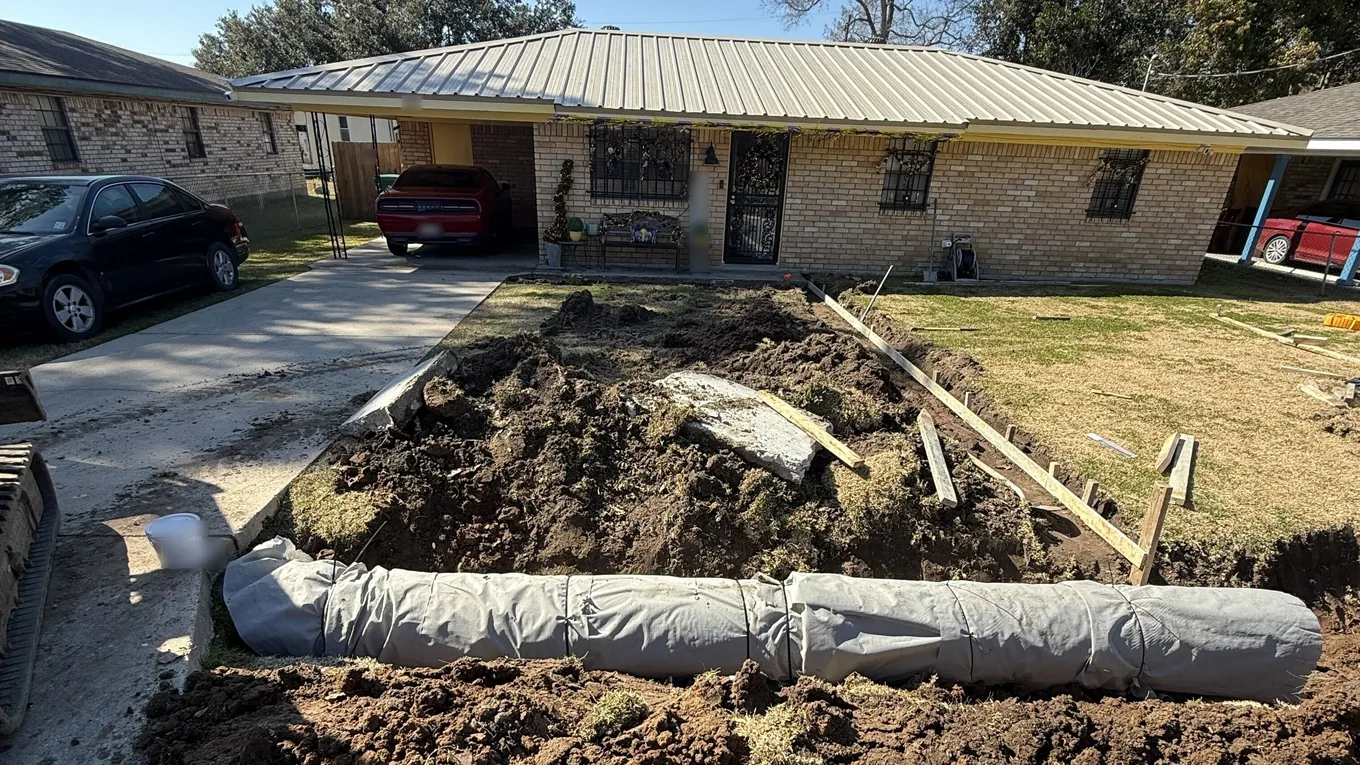
How Much Does a French Drain Cost in Louisiana?
National cost guides put an outdoor French drain at about $10 to $75 per linear foot, installed. A 100-foot run in the yard comes to about $1,000 to $7,500 in those guides.
A cost estimator site’s Lafayette page, last updated in 2024, lists $24 to $37 per foot. These are market numbers, not our price list. The depth of the trench and where the water ends up move a job up or down the range. For French drain installation around Lafayette, we look at the yard or your photos first. The quote comes in writing.
What does a French drain cost per foot and per run?
A French drain is a gravel-filled trench with a perforated pipe in the bottom. Water in the soil seeps into the gravel, and the pipe carries it downhill to an outlet.
Published ranges, side by side:
| What is priced | Published range | Kind of source |
|---|---|---|
| Outdoor French drain, per linear foot | $10 to $75 | National cost guides, 2025 and 2026 |
| Deep French drain, per linear foot | $30 to $70 | A national cost guide, 2026 |
| French drain in Lafayette, per linear foot | $24 to $37 | A cost estimator site’s Lafayette page, 2024 |
| 50-foot outdoor run | $500 to $3,250 | A national cost guide, 2025 |
| 100-foot outdoor run | $1,000 to $7,500 | National cost guides, 2025 |
| 100-foot run in Lafayette | $2,400 to $3,740 | A cost estimator site’s Lafayette page, 2024 |
| Plastic catch basin | $200 to $500 each | A national cost guide, 2026 |
| Channel drain, per linear foot | $30 to $100 | A national cost guide, 2026 |
| Regrading a yard | $800 to $4,000 | National cost guides, 2025 and 2026 |
National average jobs land at about $5,000 to $9,250. Those averages mix in interior basement systems at $40 to $100 a foot. For a drain in the yard or along a slab, read the outdoor lines.
What drives the price of a French drain?
Depth and width. The LSU AgCenter’s French drain guide describes a trench 12 to 18 inches wide and 18 to 24 inches deep. A deeper trench means more digging and more gravel.
Length. National guides price by the foot, so their 100-foot figures run about double their 50-foot figures. On flat ground, the trench also gets deeper along the run to keep the slope.
Materials. The LSU guide describes a 4-inch perforated pipe under washed gravel about 1 inch in size. Geotextile filter fabric lines the trench so silt stays out of the gravel. One guide lists the pipe at $0.50 to $3 a foot and pea gravel at $25 to $53 a ton.
The outlet. The pipe has to end lower than it starts, such as at a low spot on your lot. A roadside ditch works where the office that owns it allows the tie-in. Where no low spot exists, a pop-up emitter opens under water pressure and lets the water out over the lawn. A catch basin at a low spot adds a box and a grate to the job.
Access and soil. One national guide names access around the foundation and clay-heavy soil as labor drivers. Before any trench is dug, a call to Louisiana 811 at least two business days ahead gets buried lines marked.
Concrete in the way. If the run crosses a walk or a driveway, a section is saw-cut and poured back. If the driveway is due for replacement anyway, our driveway cost guide covers that price.
When is a French drain the right fix?
A French drain handles water in the soil, like ground that stays soggy for days after a rain. Water that runs across the top of the yard is a different problem. Other fixes move surface water faster.
- A catch basin sits at the low spot where water pools. Its grate takes in the water, and a solid pipe carries it away.
- A channel drain, also called a trench drain, is a long grate set in concrete. It catches water that sheets across a driveway or a patio.
- Regrading reshapes the ground so it falls away from the house. A swale is a shallow graded ditch that carries water around the problem.
- A downspout line carries roof water underground to an outlet.
Grading has a rule of its own. The state building code, the Louisiana State Uniform Construction Code, uses the 2021 International Residential Code for houses. Its section R401.3 says the ground should fall at least 6 inches within the first 10 feet from the foundation. Where a lot line or a wall leaves no room for that fall, the section calls for drains or swales.
Some yards need both kinds of fix, and a catch basin can feed the same pipe as a French drain. Our yard drainage work covers catch basins, channel drains, downspout lines and swales.
Why do Acadiana’s soils and water table change the job?
NOAA’s 1991 to 2020 normals put Lafayette Regional Airport at about 63 inches of rain a year.
NRCS soil surveys map Frost and Coteau silt loams across large parts of the Lafayette area. Frost silt loam is poorly drained and slowly permeable. From December through April in most years, its wet layer starts no deeper than a foot and a half. Coteau silt loam drains somewhat poorly. In winter and spring, the soil 1.5 to 3 feet down can stay saturated for up to a month. Along Bayou Teche, NRCS maps heavy clays such as Sharkey and Iberia.
What that means for a French drain:
- A trench 18 to 24 inches deep can sit in wet soil through much of the winter. The pipe carries water only while the outlet sits lower than the pipe.
- Flat yards leave little fall, so finding a lower outlet can be the hardest part of the job.
- The LSU AgCenter notes that a dry well will not help much where the soil does not drain well.
- Silt travels with water, and filter fabric keeps it from clogging the gravel.
Can a French drain send water onto a neighbor’s yard in Louisiana?
Louisiana Civil Code article 655 says land below must receive the surface water that flows naturally from land above. The exception is a flow that an act of man created. Article 656 says the landowner below may not block that natural flow. The landowner above may not do anything to make that burden heavier.
A drain pipe is man-made. Piping collected water onto the lot next door can cross that line. The LSU AgCenter advises sending drain water to a storm drain or a pond, not toward a neighbor’s property. This is general information, not legal advice. A Louisiana attorney can answer for a specific property line.
We plan where the water ends up before a trench is dug. The Lafayette Consolidated Government (LCG) allows nothing in its drainage system without written Public Works approval. Other towns set their own rules, and we point you to the right office.
How do you get a real number for your yard?
Market ranges show the spread, and your yard sets the actual number. We look at the yard, or you send photos taken after a rain. Then we put the quote in writing.
Our page on how we build French drains in Acadiana walks through the trench and the outlet. Building a new house or an addition? The grading and drains belong in the plan for the slab foundation and footings. Call or text (337) 520-8615.