
Swale vs French Drain: Which One Fixes a Wet Yard in Louisiana?
A swale moves water that runs across the top of the ground. A French drain collects water that has soaked into the soil or sits in a low spot. It carries that water away underground in a perforated pipe.
Which one fits depends first on where the water comes from. The room on your lot and a legal place to send the water decide the rest. Some yards need both. We build both as part of yard drainage work around Lafayette and across Acadiana.
What is a swale?
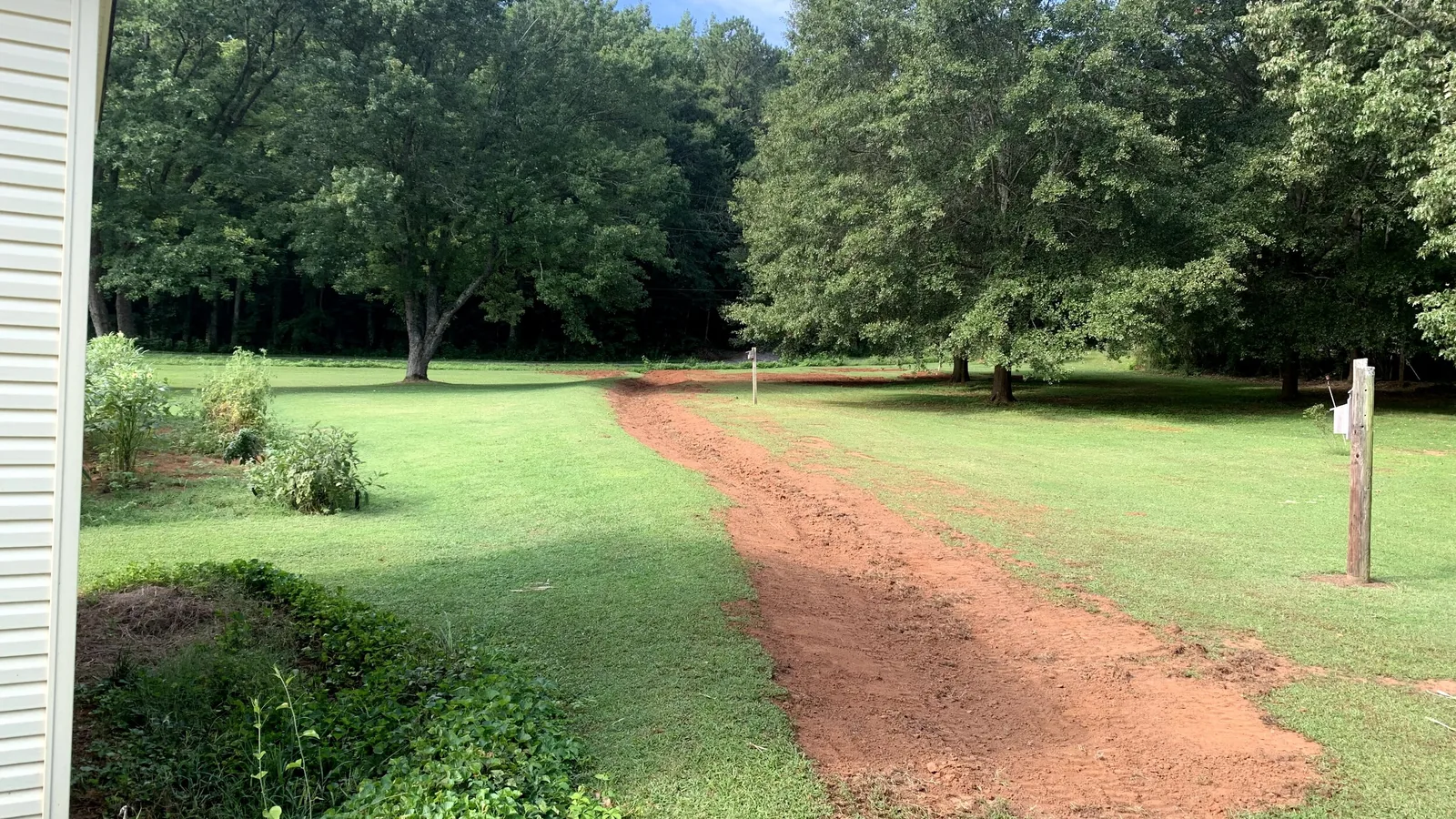
The EPA describes a grassed swale as a vegetated, open channel, an improvement on the traditional drainage ditch. As stormwater flows along it, the grass slows the water down. In a yard, a swale is a wide, shallow dip graded into the lot, with gentle sides. Runoff follows it to a ditch, the street side of the lot or another approved outlet.
Swales work best on fairly flat ground. EPA says design documents generally recommend a 1 to 2 percent slope, since steeper channels erode. A swale also needs room, because it takes a fairly large area of ground that soaks up water.
We shape a swale as part of a yard drainage job. Seeding or sodding it afterward is the homeowner’s part, or a landscaper’s.
What is a French drain?
The LSU AgCenter calls a French drain a subsurface system. Its guide describes a trench 12 to 18 inches wide and 18 to 24 inches deep. A perforated pipe, typically 4 inches across, sits in the bottom under washed gravel, typically 1 inch in size. Geotextile fabric keeps washed-in soil out of the gravel.
Water in the soil seeps through the gravel into the pipe, which carries it to an outlet. A university extension guide slopes the trench between 0.5 and 1 percent. Our page on French drain installation covers how we dig the trench and plan the outlet.
Which one does your yard need?
Start where the LSU AgCenter guide starts: watch where water ponds and the paths it takes in a storm. Water that sheets across the lawn is surface water. It runs off the roof, the driveway or higher ground next door. A swale catches it and steers it around the house.
Ground that stays soggy for days after the rain stops is a different problem. That water has soaked in, and a French drain gives it a way out underground.
A tight side yard between two houses rarely has room for a wide swale. On a flat lot, a pipe can get its fall by running deeper along the trench. A swale that deep turns into a ditch.
What does Louisiana’s building code say about grading?
Louisiana’s residential code is based on the 2021 International Residential Code. Section R401.3 says the ground should fall at least 6 inches in the first 10 feet from the foundation. Surface water goes to the storm drain system or another approved point of collection.
Where lot lines, walls or slopes leave no room for that fall, the code calls for drains or swales. In that case, hard surfaces within 10 feet of the foundation slope at least 2 percent away. So the code names both fixes. Questions about a specific lot go to the parish or city permit office, and we point you there.
Why do yards around Lafayette stay wet?
NOAA’s 1991 to 2020 normals put Lafayette Regional Airport at about 63 inches of rain a year. NRCS rates Frost soils, the most common in Lafayette Parish, as poorly drained, with very slow runoff and slow permeability. In most years, they are wet within 0 to 1.5 feet of the surface from December through April.
A French drain moves water only while its outlet sits lower than the pipe. So it needs a real outlet and steady fall. A swale needs room and somewhere legal to send the water.
For the dry, grassy kind of swale, EPA guidance keeps the bottom at least 2 feet above the groundwater table. Ground this wet in winter makes a swale here a path for runoff. Soggy ground underneath needs a pipe.
How do a swale and a French drain compare?
| Swale | French drain | |
|---|---|---|
| What it handles | Runoff moving across the top of the ground | Water that soaks in or sits in a low spot |
| How it is built | A wide, shallow grass channel graded into the lot | A gravel trench with filter fabric and a perforated pipe |
| Space it takes | A wide strip of open ground with gentle sides | A trench 12 to 18 inches wide |
| Slope | 1 to 2 percent in typical design documents | 0.5 to 1 percent in an extension guide |
| What you see afterward | A gentle dip in the lawn | Gravel or grass over the trench, plus any grate or pop-up emitter |
| Upkeep | Mow to 3 to 4 inches, clear debris, fix washed-out spots | Clear grates and the outlet, and hose out a clogged pipe |
| Market cost | $5 to $15 per linear foot, or $0.50 to $1.00 per square foot | $10 to $35 per linear foot |
The cost row comes from a national cost guide. The same guide puts regrading and resloping a yard at $500 to $5,000 on average. These are market numbers, not our price list.
When does a yard need both?
Some yards have both problems, and the two fixes work together.
- A swale can end at a catch basin, a box with a grate at the low spot. A solid pipe carries the water on from there.
- Where a swale cannot get enough fall, a French drain can carry the water underground.
- On a slope, a swale above the house turns runoff aside. A French drain lower down picks up what soaks in.
When a swale or a drain line ends at a roadside ditch, check the pipe under the driveway too. A crushed or silted culvert can back the ditch up into the yard. Replacing it is our driveway culverts work. In the Lafayette Consolidated Government’s area, nothing goes into the public drainage system without written approval from Public Works.
Where is the water allowed to go?
Every swale and French drain needs an outlet lower than where it starts. The LSU AgCenter says larger properties can send water to ponds, ditches, culverts and low areas. On smaller lots, it says to check local rules and not make your excess water the neighbor’s problem.
Under Louisiana’s Civil Code, article 655 says lower land must receive the surface water that flows naturally from higher land. A flow an act of man created is the exception. Article 656 says the owner above may not make that burden heavier, and the owner below may not block it.
Swales and drain lines are man-made, so aiming one at the lot next door can cross that line. This is general information, not legal advice. A Louisiana attorney can answer for a specific lot.
How do you get the right fix for your yard?
Watch the yard during a hard rain, and take photos of where the water runs and where it stands. A day later, note which spots are still soggy. We look at the yard, or you send photos, and we put the quote in writing.
Our yard drainage service covers swales, catch basins, channel drains and downspout lines. Call or text (337) 520-8615.